Container pricing in Australia moves constantly, which is why any figure written into an article is out of date within weeks. What does not change is why one container costs more than another. If you understand the seven or eight factors that set the price, you can read a quote properly, work out where you have room to save, and know whether the number in front of you is fair. Live pricing for current stock sits in the online shop, GST-inclusive, with delivery a flat $350 to any address in Australia.
1. New (one-trip) versus used
This is the largest single driver, and it is worth understanding what the labels mean. A new or “one-trip” container was manufactured recently, loaded once for its delivery voyage to Australia, and discharged here. It has original paint, sound seals, an undamaged floor and doors that operate cleanly. It is not literally untouched — it has been at sea — but cosmetically and structurally it is close to factory condition.
A used container has spent years in international service. Used stock is graded, and the grade is where the price steps down: cargo-worthy units still certified for shipping, wind-and-watertight units fit for storage but not re-certified, and lower grades with dents, patched repairs, surface rust or heavier wear. The gap between a one-trip and a mid-grade used container of the same size is substantial, and for pure storage on a farm or a yard, the used unit is often the sensible buy. For anything you will look at daily, fit out, or put in front of customers, the one-trip almost always earns the difference back.
2. Size — and why it is not proportional
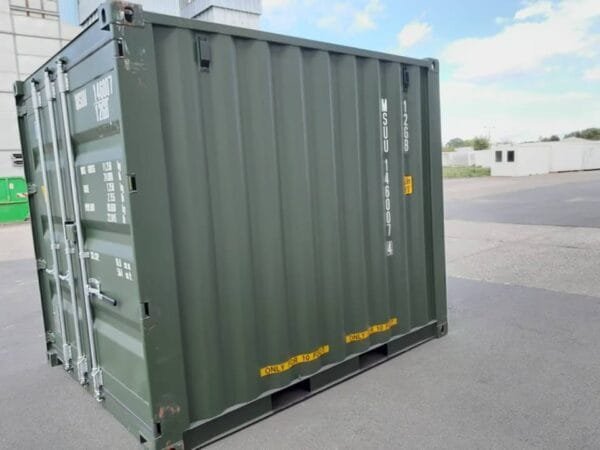
A 40ft container is not twice the price of a 20ft. It uses roughly twice the steel but costs the same to handle and lift, and the market for 40ft units is deeper, so the price per cubic metre of a 40ft is usually the best value on the board. Small sizes work the other way: 10ft and 12ft containers are typically cut down from larger units by a fabricator, which adds labour, a new end wall and a re-weld, so they can cost close to a 20ft despite holding half as much. You are paying for the small footprint, not the volume.
High cube adds a modest premium over standard height for the same length. It is one of the cheapest upgrades available and the one buyers most often wish they had taken.
3. Where you are, and where the depot is
Containers are cheapest where the shipping industry leaves them, which means the port cities: Sydney, Melbourne, Brisbane, Fremantle and Adelaide. Inland and regional Australia often pays more for the box itself — and that has nothing to do with getting it to you, since delivery is a flat $350 wherever you are. Depots away from the coast hold smaller, shallower stock, so the unit you want may have to be repositioned from a port before it can be sold to you, and that repositioning is a cost baked into the container price.
This produces one of the more counter-intuitive facts in container buying: two identical 20ft containers can differ meaningfully in price purely on which capital city they are sitting in this month.
4. Depot availability and stock depth
Availability is not a yes-or-no. At any given time a depot might have twenty 20ft used units and a single 40ft high cube one-trip in the colour you asked for. When stock is deep, prices sit at the market rate. When a size, grade or colour is thin, the price firms and you may be offered a unit from another state instead.
Practical consequence: flexibility is worth real money. If you can accept a different colour, take a standard height instead of a high cube, or wait for the next intake, you will usually pay less than the buyer who needs one specific configuration this Friday.
5. Delivery and site access
Delivery is the one line on the quote that does not move. It is a flat $350 to any address in Australia, GST inclusive, arriving 7 to 10 days from order confirmation. It is not worked out from kilometres, postcode or state, and there is no rural, remote, regional or fuel surcharge — a run out to western Queensland, the Territory or the Pilbara is charged exactly the same as a run across Sydney, and quoted the same lead time.
What your site still decides is whether that standard delivery is enough, and whether it succeeds first time:
- Truck type. A tilt-tray slides the container off the back onto prepared ground and suits most straightforward sites, and it is covered by the flat fee. A side-loader lifts the container off the side of the trailer with its own cranes and can place a box in far tighter spots, but is a more expensive machine to hire and is quoted separately.
- Crane assistance. Lifting a container over a fence, over a structure, or precisely onto prepared footings needs a crane. Crane hire sits on top of the flat delivery fee and is quoted before you commit.
- Site access. Narrow gates, soft ground, steep driveways, low branches, overhead powerlines and tight turning circles are what turn a booked delivery into a failed one. A site that needs a second attempt is charged a redelivery fee, so an unprepared site is the expensive kind.
The single best thing you can do to keep delivery at the $350 and nothing more is to prepare the site properly before the truck arrives — level, firm, clear, with a straight approach.
6. Modifications
Every cut into a container’s steel skin is labour plus material plus, in most cases, reinforcement to restore what the cut removed. In rough order of cost, from modest to major:
- Lock boxes, vents, shelving and internal lighting.
- Personnel doors and windows with security bars or shutters.
- Roller doors, especially full-width ones that require substantial framing.
- Lining and insulation — spray foam, rigid panel or framed batts, plus internal cladding and flooring.
- Electrical fit-out to Australian standards, tested and certified by a licensed electrician.
- Full cabin and office conversions with partitions, split systems, plumbing or a kitchenette.
- Reefers (refrigerated units) and container cool rooms, where you are also buying and running a refrigeration machine.
Modifications compound: a container office is not a container plus a door, it is a container plus a door plus framing plus insulation plus lining plus wiring plus a certificate. That is why a fitted cabin sits in a different price bracket entirely from a bare box.
7. Market conditions
Container prices track global shipping. When trade flows are unbalanced and empty boxes pile up in Australian ports, used stock is plentiful and cheap. When freight rates spike and boxes are being repositioned back overseas, local supply tightens and prices rise — sometimes quickly. Steel input costs, the AUD exchange rate, and manufacturing output all feed into what a one-trip container lands at. None of this is predictable enough to time, but it does explain why a price you were quoted last year is no guide to today.
What to check before you compare quotes
- Is it GST-inclusive? Ours are. A quote that looks 10 per cent cheaper may simply be ex-GST.
- Is delivery in or out? Compare landed prices on your site, not depot prices. Ours is a flat $350 to any Australian address.
- What grade, exactly? “Used” covers a wide range. Ask whether it is cargo-worthy or wind-and-watertight, and what the floor and doors are like.
- What is the truck, and what does the site need to be? A cheap delivery that fails on arrival is not cheap.
- Are the doors serviceable? Seized locking bars and perished seals are the most common source of regret on bargain units.
Our buyer’s guide goes deeper on grading and what to inspect. For a current price on a specific size and grade, check the shop or email sales@shippingsolutionspty.com — or call 1300 000 000 and describe your site, and we will confirm the container price, the flat $350 delivery and the 7 to 10 day lead time.