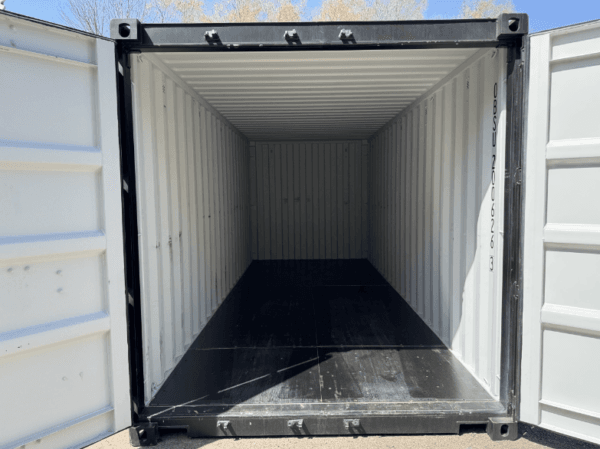
Container sizes are quoted in feet because the shipping industry standardised on imperial lengths decades ago, but everything you actually need to plan a slab, a shed pad or a truck route is metric. This guide converts the lot: external and internal dimensions in metres, door openings, internal volume in cubic metres, payload in tonnes, and a plain-English sense of what genuinely fits inside each size.
The quick answer
Almost every container sold in Australia is 2.438 m wide externally. Only two things change between sizes: length and height. Standard height is 2.591 m; a high cube adds 305 mm, taking the external height to 2.896 m. That extra foot of headroom is the single most consequential choice most buyers make, because it is the difference between a storage box and a space you can stand in comfortably once a floor and ceiling lining go in.
External dimensions
External figures are what you need for site planning: the pad, the setbacks, the clearance to a fence, the space the truck has to place it into.
| Size | Length | Width | Height |
|---|---|---|---|
| 10ft standard | 2.991 m | 2.438 m | 2.591 m |
| 12ft standard | 3.65 m (approx.) | 2.438 m | 2.591 m |
| 20ft standard | 6.058 m | 2.438 m | 2.591 m |
| 20ft high cube | 6.058 m | 2.438 m | 2.896 m |
| 30ft standard | 9.125 m (approx.) | 2.438 m | 2.591 m |
| 40ft standard | 12.192 m | 2.438 m | 2.591 m |
| 40ft high cube | 12.192 m | 2.438 m | 2.896 m |
A note on the odd sizes. The 10ft, 20ft and 40ft lengths are true ISO sizes built as such in the factory. 12ft and 30ft containers are almost always cut-downs — a longer container shortened and re-ended by a fabricator — so their length can vary by 50–100 mm between suppliers and the door end may differ from the sealed end. If you are building the container into a structure where a precise length matters, ask for the measured dimensions of the actual unit rather than working from a table.
Internal dimensions, volume and door openings
Internal figures are what you need for what goes inside: pallets, racking, a vehicle, a fit-out. Steel walls are corrugated, so the usable width between the corrugation peaks is slightly less than the internal width quoted at the troughs — allow around 30 mm if you are building cabinetry hard to the wall.
| Size | Internal L × W × H | Door opening (W × H) | Volume |
|---|---|---|---|
| 10ft standard | 2.83 × 2.35 × 2.39 m | 2.34 × 2.28 m | ~16 m³ |
| 12ft standard | 3.49 × 2.35 × 2.39 m | 2.34 × 2.28 m | ~19.5 m³ |
| 20ft standard | 5.90 × 2.35 × 2.39 m | 2.34 × 2.28 m | ~33 m³ |
| 20ft high cube | 5.90 × 2.35 × 2.70 m | 2.34 × 2.58 m | ~37 m³ |
| 30ft standard | 8.96 × 2.35 × 2.39 m | 2.34 × 2.28 m | ~50 m³ |
| 40ft standard | 12.03 × 2.35 × 2.39 m | 2.34 × 2.28 m | ~67 m³ |
| 40ft high cube | 12.03 × 2.35 × 2.70 m | 2.34 × 2.58 m | ~76 m³ |
The door opening is the number people forget. It is lower than the internal height — roughly 110 mm lower on a standard, because of the header above the doors — and narrower than the internal width because of the door frame posts. If you plan to drive a vehicle, a ride-on mower or a forklift in, measure the machine’s highest and widest point and compare it to the door opening, not the internal cavity.
Weights and payload
Tare is the empty weight of the container. Maximum gross is the rated limit for the box itself under the ISO plate. Payload is the difference.
| Size | Tare (approx.) | Max gross | Payload |
|---|---|---|---|
| 10ft | ~1.3 t | ~10.2 t | ~8.9 t |
| 20ft standard | ~2.2 t | 30.48 t | ~28 t |
| 20ft high cube | ~2.4 t | 30.48 t | ~28 t |
| 40ft standard | ~3.8 t | 30.48 t | ~26.6 t |
| 40ft high cube | ~3.9 t | 30.48 t | ~26.5 t |
Two Australian realities cut across those numbers. First, road mass limits, not the container plate, usually govern: what a tilt-tray or side-loader can legally carry on a given route and axle configuration will typically cap a loaded 20ft well below 28 tonnes. Second, tare varies by manufacturer, age and any modifications — a container with a personnel door, windows and insulation will be heavier than the factory figure. If you are hiring a crane or planning a lift, get the tare from the CSC plate on the door and add your contents.
What actually fits in each size
10ft and 12ft
The small sizes are about site footprint, not volume. A 10ft fits on a suburban block, through a wider-than-average side gate on a tilt-tray, and inside most setback rules with room to spare. It comfortably takes the contents of a one-bedroom unit, a tradesperson’s tools and materials, or a lockable site store. Two standard Australian pallets fit side by side across the width; a 10ft takes about four.
20ft
The default. A 20ft holds roughly ten standard pallets on the floor, the contents of a two- to three-bedroom house packed properly, or a small car with room around it. It is the size most commonly converted into a site office, lunchroom or tool store, and the size most depots hold the deepest stock of in every capital city and most regional hubs. If you are undecided, a 20ft high cube is the sweet spot: same footprint, meaningfully more usable headroom once you line the ceiling.
30ft
A niche size that solves a specific problem — you need more than a 20ft, but a 40ft will not fit the pad or the access. Because they are cut-downs, availability is patchy and stock is not always on hand.
40ft and 40ft high cube
Twenty or so pallets on the floor, a full household plus vehicles, or the raw material for a two-room office fit-out with a separating wall. The 40ft high cube is the standard starting point for habitable conversions and insulated builds, because once you lose 100 mm to floor build-up and 100 mm to ceiling insulation you still have a sensible ceiling height. Be honest about access before you commit: delivering a 40ft needs a long, straight, firm approach and a swing space most residential blocks do not have.
Choosing a size in practice
- Start with the site, not the contents. The pad, the gate, the turning circle and the overhead wires will rule out sizes faster than your storage list will.
- Buy the height, not the length. Upgrading from standard to high cube costs far less than upgrading from 20ft to 40ft and usually solves the same problem.
- Two 20ft beat one 40ft when access is tight, when you want to separate uses, or when you may move one later.
- Check the door end. If you need to load with a forklift, you need door-end clearance for the forklift plus its load, not just the container.
If you want to compare grades and configurations against these dimensions, our buyer’s guide walks through new one-trip versus used grading, door options and modifications, and current stock and sizes are listed in the online shop, with delivery a flat $350 to any address in Australia. If you are not sure which size suits your site, email sales@shippingsolutionspty.com or call 1300 000 000 with your access measurements and we will tell you what will fit.